
Form 5472: What Foreign Owners of U.S. LLCs Should Know About the New IRS Guidance

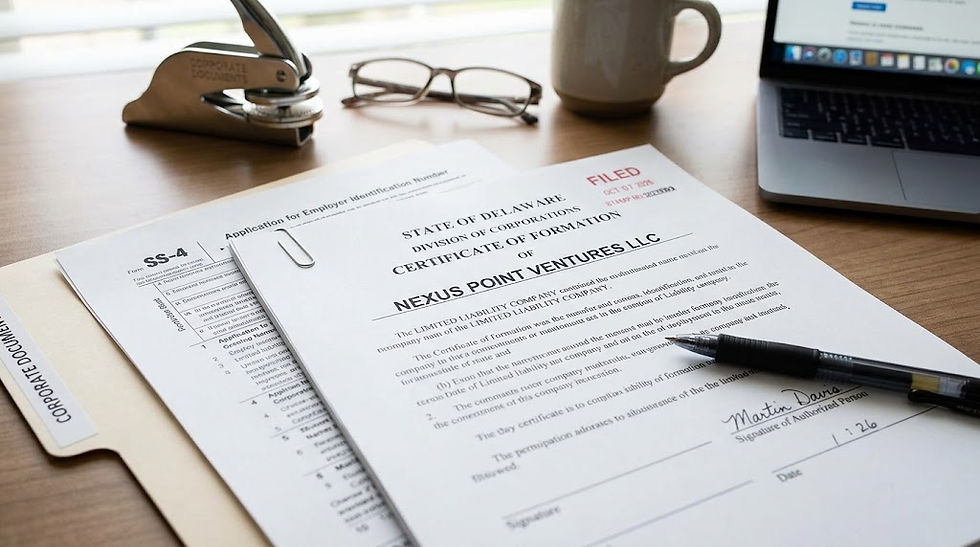
A U.S. LLC with a single foreign owner files no income tax return of its own, and many owners conclude that it files nothing at all. That is wrong. Since 2017 such an LLC must file Form 5472 each year, and the penalty for a missed filing starts at $25,000. We introduced the subject in our earlier post, Foreign-Owned U.S. LLCs and Form 5472. This post sets out the filing requirement in more detail and then turns to a welcome development: on April 24, 2026, the IRS released Chief Counsel Advice 202617012, which explains when a small company that missed the filing can obtain penalty relief. Galia Antebi of Ruchelman P.L.L.C. has written a clear analysis of the guidance, “Form 5472 and Foreign-Owned U.S. Entities: The New Chief Counsel Guidance” (Insights, Vol. 13, No. 5, September 2026), which also appears on Mondaq. We recommend the full article. A summary and our own comments follow.
The Filing Requirement
The rules are set out in the IRS Instructions for Form 5472 (Rev. December 2024). In brief:
Who must file. A U.S. LLC that is disregarded for income tax purposes and is wholly owned by one foreign person is a “foreign-owned U.S. disregarded entity.” For Form 5472 purposes it is treated as a corporation. A foreign person includes a non-resident individual, a foreign company, and a foreign trust or estate. The rule applies to tax years beginning on or after January 1, 2017.
What triggers the filing. A reportable transaction with the foreign owner or another related party during the year. For a disregarded LLC the net is wide: it covers sales, rents, loans, and interest, and it also covers amounts paid or received in connection with the formation, dissolution, acquisition, and disposition of the LLC, including contributions to it and distributions from it. Money that the owner wires to the LLC, and routine expenses that the owner pays on its behalf, are contributions. The exception for transactions between two non-U.S. persons that produce no U.S. income does not apply to a disregarded LLC.
How to file. The LLC files a pro forma Form 1120 with only its name, address, and items B and E completed, writes “Foreign-owned U.S. DE” across the top, and attaches Form 5472. A separate Form 5472 is filed for each related party. The LLC needs an employer identification number, and the form asks for the owner’s foreign taxpayer identification number.
When to file. The return is due on the due date of Form 1120, including extensions. For a calendar-year LLC that is generally April 15. Form 7004 extends the due date by six months and is sent to the same address as the return.
Where to file. A foreign-owned disregarded LLC cannot file electronically. It faxes the return to 855-887-7737 or mails it to Internal Revenue Service, 1973 Rulon White Blvd., M/S 6112, Attn: PIN Unit, Ogden, UT 84201. The ordinary Form 1120 addresses must not be used.
Penalties. A penalty of $25,000 applies to each failure to file, and a substantially incomplete form counts as a failure. The same penalty applies to a failure to keep the records that support the form. If the failure continues more than 90 days after IRS notice, a further $25,000 applies for each 30-day period, with no cap.
The New Guidance
Ms. Antebi explains that the regulations, Treas. Reg. § 1.6038A-4, already direct the IRS to apply the reasonable cause exception “liberally” to a small corporation, meaning one with gross receipts of $20 million or less, that had no knowledge of the Form 5472 requirement, had limited presence in and contact with the United States, and promptly and fully complied with IRS requests. Until now there was no guidance on what “liberally” meant. The CCA supplies it. The company shows that it qualifies through a written statement, signed under penalties of perjury, that addresses all four conditions: size, lack of knowledge, limited U.S. presence, and prompt corrective compliance. “Liberal” application means a lower level of scrutiny, not automatic relief, and a conclusory statement is not enough.
She draws out two practical points. On knowledge, the IRS may ask whether the owner controls any other entity that has filed Form 5472. On presence, an LLC that holds only foreign assets presents a strong case, while an LLC that owns U.S. real estate presents a closer one, particularly where the property is rented. The article closes with a parallel to Form 3520 for foreign gifts, where the same mistake, assuming that a non-taxable transfer requires no information return, leads to a different penalty regime.
Our Perspective
Milan Solarz-Patel, J.D., LL.M. (Taxation), of Auric Private Client Advisory LLC adds three points from practice.
1. The Buyer of U.S. Real Estate Is the Usual Victim
In our practice the filing is missed most often by non-U.S. buyers of U.S. real estate who hold the property through a U.S. LLC. The pattern is consistent. The closing attorney or a formation service sets up the LLC, the buyer wires the purchase price, the family uses the property, no income arises, and no one mentions Form 5472. Every step is a reportable transaction: the wire that funds the purchase is a contribution, and so is each later payment of property tax, insurance, and association dues that the owner makes from abroad. By the time the owner asks, several years have usually passed. These owners are also the group for whom the CCA matters most. A personally used property with no tenants, no U.S. employees, and an owner who lives abroad fits the small corporation provision well, and the statement should say so with specifics.
2. The Statement Is the Case
The CCA tells the practitioner what the statement must prove. The four conditions are the headings, and each heading needs facts rather than conclusions:
Size. Gross receipts for the year, worldwide and not only from U.S. sources. For a holding LLC the figure is often zero, and the statement should say so.
Knowledge. Who owned and controlled the LLC when the return was due, where they live, and whether they have ever filed Form 5472 or controlled another entity that did. Where the owner is a foreign trust, this condition is tested at the level of the trustee. A professional trustee that administers other structures with U.S. filings should expect that history to be considered.
Presence. The LLC’s assets and activity, and the absence of U.S. customers, employees, offices, and dealings with U.S. government agencies. Where the LLC holds U.S. real estate, describe the use of the property and the people with whom the LLC deals.
Compliance. The date on which the owner learned of the requirement, the date on which each delinquent return was filed, and the fact that every year and every related party has been covered.
The statement should invoke the small corporation provision by name. The CCA suggests that the IRS may raise the provision on its own where the facts point to it, but no one should rely on that.
3. File Before the IRS Asks, and Raise Every Argument
The third condition is prompt and full compliance with IRS requests. A company that files every delinquent year voluntarily, with the statement attached to each return, has complied before any request is made. In our experience that is the strongest position from which to seek relief, and it also prevents the continuation penalty from starting, since that penalty runs from an IRS notice. Where a family holds several LLCs, each one is a separate reporting corporation and needs its own returns and its own statement.
Ms. Antebi also notes two relief paths that are easy to miss. They are found in the Internal Revenue Manual 20.1.9.5.5 rather than in the CCA itself. When Form 5472 is attached to a late pro forma Form 1120, the IRS assesses the Form 5472 penalty systemically. If the Form 1120 failure-to-file penalty is removed for reasonable cause, the Form 5472 penalty is removed on the same basis. If the Form 1120 penalty qualifies for first-time abatement, the Form 5472 penalty is removed as well, even though the section 6038A penalty is not otherwise eligible for first-time abatement. The IRM extends this to a Form 1120 on which no failure-to-file penalty was assessed because no tax was due, which is the usual position of a disregarded LLC. Both arguments belong in the request where the facts support them.
The Takeaway
The CCA does not change the filing requirement. It changes the odds for a small foreign-owned LLC that missed it. File every delinquent year now, attach a statement signed under penalties of perjury that addresses the four conditions with facts, invoke the small corporation provision by name, and raise the Form 1120 arguments where they apply.
If you own a U.S. LLC from abroad, hold U.S. real estate through one, or are a trustee or advisor to a foreign trust that holds one, and Form 5472 has not been filed, see our services or contact Auric Private Client Advisory LLC. For the background, see our earlier post, Foreign-Owned U.S. LLCs and Form 5472. For the related rules on foreign gifts and foreign trusts, see Form 3520.
Source and credit: Galia Antebi, Ruchelman P.L.L.C., “Form 5472 and Foreign-Owned U.S. Entities: The New Chief Counsel Guidance,” Insights, Vol. 13, No. 5 (September 2026), also published on Mondaq. The IRS guidance is Chief Counsel Advice 202617012 (released April 24, 2026). This post summarizes and comments on Ms. Antebi’s article. The comments are those of Auric Private Client Advisory LLC.

Comments